When a storm, flood or fire cuts off water and sewer service, San Rafael Porta Pros can usually get standard units on site within hours, not days. A single unit runs $100 to $350 a day depending on term and access, and we scale from a handful of toilets to a full command-post setup with handwashing stations and restroom trailers.
Speed depends on road access and how many units the situation needs, but our emergency porta potty rental crews prioritize disaster calls ahead of routine deliveries. A roll-off delivery truck needs about 60 feet of straight clearance behind it, which matters when streets are blocked by debris or downed lines, so tell dispatch about access before the truck rolls. We stage standard units and ADA accessible units out of San Rafael and can reach San Anselmo 4.3 miles west or Larkspur 5.1 miles southwest inside the same response window. Mill Valley sits 8.7 miles south and Novato 11.0 miles north, both still workable for same-window delivery when conditions allow. If the disaster has knocked out a building's plumbing entirely, a holding tank rental can bridge the gap for a shelter kitchen or a triage tent until permanent systems come back online. For sites needing potable water alongside toilets, OSHA 1926.51(a)(1) requires an adequate supply of potable water at all places of employment, which applies to relief operations staffed by workers as much as it does a normal job site. We also bring light towers and temporary power poles when a shelter or staging area has no grid power at all.
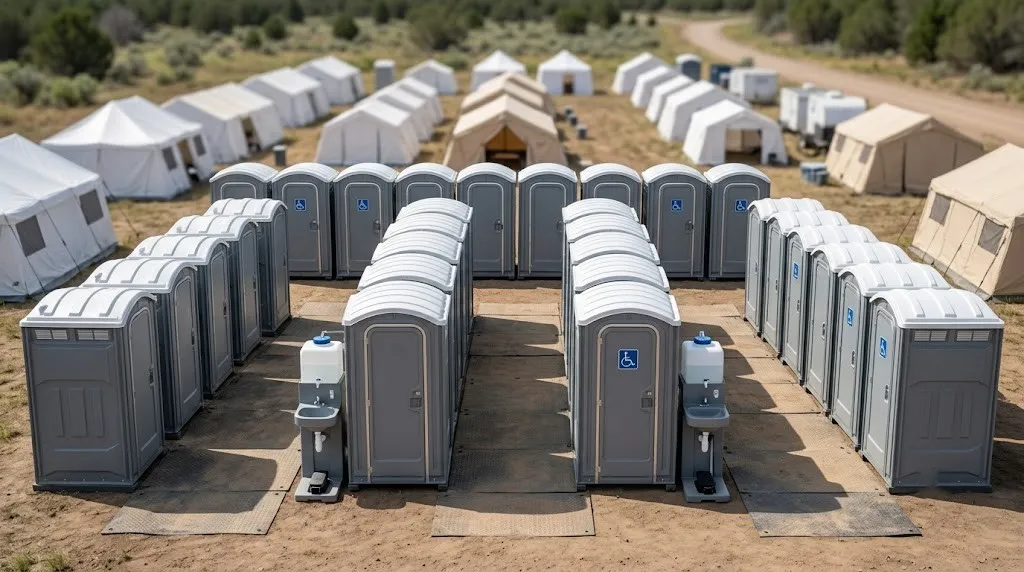
A shelter housing displaced residents needs more than toilets stacked in a parking lot; it needs a working ratio, handwashing, and a plan for waste removal that does not stall out after day three. OSHA 1926.51(c) sets the baseline most relief planners still use for reference: one toilet facility per 20 people, stepping up to one toilet and one urinal per 40 from 20 people up, and one per 50 once headcount passes 200. Our portable toilet rental page walks through how that scales for a shelter population that grows and shrinks as people come and go. Pair every cluster with a portable sink rental or a bank of hand sanitizer stations, because 29 CFR 1910.141(d)2 requires soap and towels or a hand-drying device at washing facilities; sanitizer alone does not meet that standard for a staffed operation. If the site includes an accessible route for elderly or mobility-impaired residents, ADA Standards section 403.5.1 calls for a minimum 36 inch clear path, and section 213.2 requires at least one accessible unit in any cluster of single-user toilets, never fewer than one no matter how small the group. Command posts running on generator power should also look at storage container rental for secure equipment and supply storage while the site is unattended overnight.
Yes. Weekly and monthly terms exist because disaster response rarely wraps in a day, and pricing steps down per-day cost the longer a unit stays. A standard unit runs $130 to $500 for a week or $125 to $325 for a month, and a monthly porta potty rental makes sense once a shelter or FEMA-adjacent staging site is expected to run past two weeks.
| unit | day | week | month |
|---|---|---|---|
| standard | $100-$350 | $130-$500 | $125-$325 |
| ADA unit | $200-$400 | $240-$400 | -- |
| deluxe flushable | $85-$1200 | $150-$290 | -- |
Delivery adds a separate fee, typically $100 to $500 for a single trip or $50 to $150 weekly if service continues on a route. For a wider county footprint, we also reach San Pablo 14.5 miles east, useful if a relief effort spans multiple staging points across Marin and into Contra Costa. Longer operations often add a temporary fence rental around a supply depot or generator bank, since OSHA 1926.202 calls for barricades meeting ANSI D6.1 wherever workers need to be kept clear of equipment or hazards. If your relief site is also handling debris removal from damaged structures, a roll-off dumpster rental keeps ANSI-compliant waste flow going per OSHA 1926.252, which covers disposal of waste materials including chutes and enclosures. See our construction site services page for how these pieces combine on a working relief site, and the service areas page for full coverage.
Under OSHA 1926.51(c), 200 people lands right at the one-per-50 tier, so plan for four toilet and urinal combinations minimum. Shelters often add extras for peak meal times. Check our how many porta potties do I need guide for the full breakdown by headcount.
Yes, ADA accessible units are available and follow ADA Standards section 304.3.1 for turning space and section 404.2.3 for door width. At least one accessible unit belongs in any cluster, per section 213.2. See ADA accessible porta potty for specs.
Often yes, especially for standard units already staged near San Rafael. Response time depends on road conditions and how many units the incident needs. Call ahead with an access description; a roll-off truck alone needs 60 feet of clearance behind it.
A holding tank rental works as a bridge system, and deluxe flushable units carry their own onboard supply. Pair either with a portable sink rental so handwashing standards under 29 CFR 1910.141(d)(2) are still met on site.
Yes. We regularly reach San Anselmo, Larkspur, Mill Valley, Novato and San Pablo from our San Rafael base, with driving distances ranging from 4.3 to 14.5 miles depending on the town.
Yes. San Rafael Porta Pros delivers disaster relief sanitation across San Rafael and the surrounding metro, with same-day and next-day drop-off available on most orders.
Pricing depends on the unit and how long you need it. See our cost breakdown and request a free quote for an exact figure.
Standard rentals include scheduled service — a pump-out, a clean, a restock and fresh deodorizer. Busy or hot-weather sites can be serviced more often.
Call now or request a free quote — clean units, on-time delivery, transparent pricing.